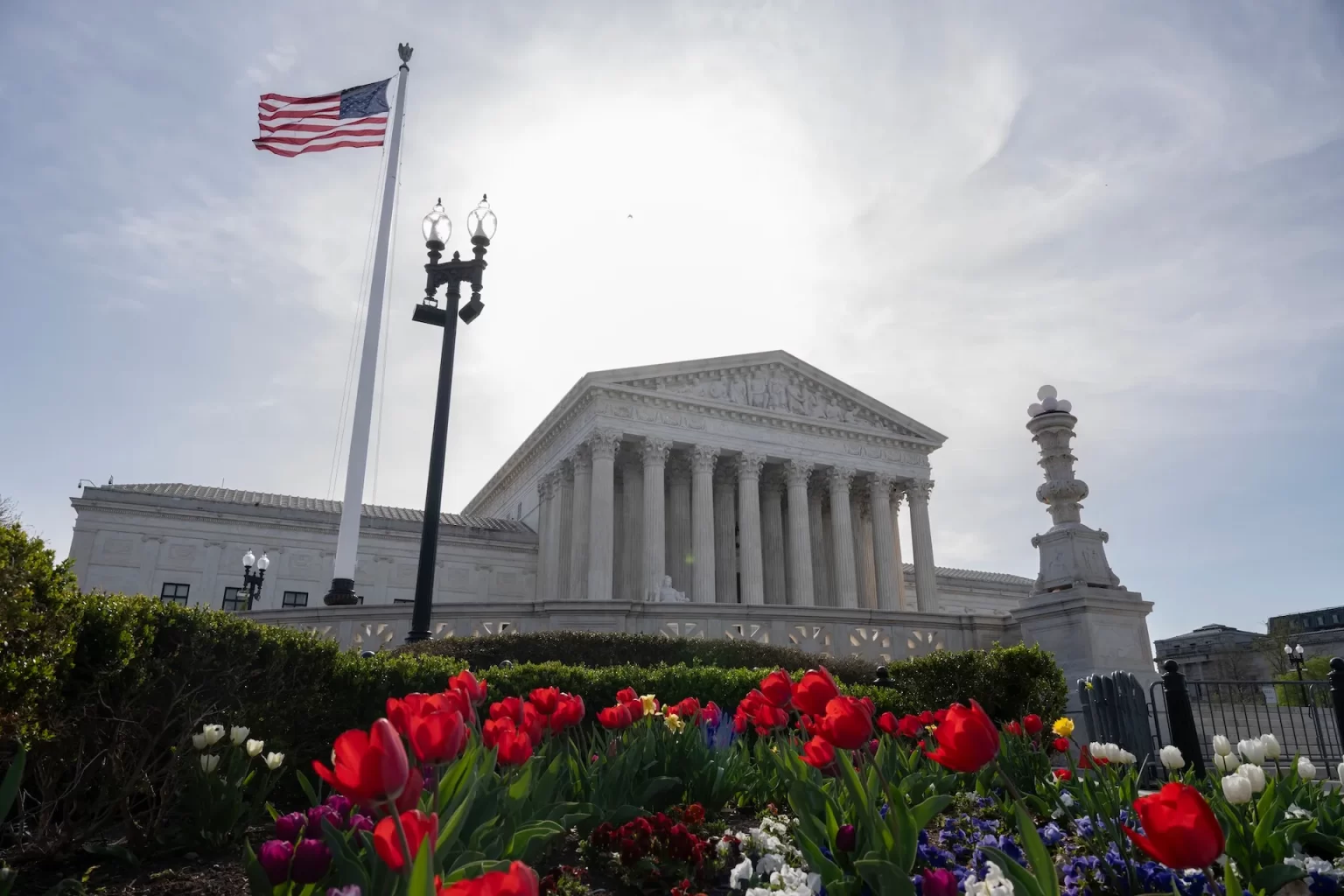
The Supreme Court will hear oral arguments Monday in a case that could limit the government’s ability to obtain bulk digital data of device users with a single warrant, in a rare instance of the country’s top justices taking on digital rights.
Chatrie v. The United States is the first major Fourth Amendment case the court has taken up since 2018, despite the proliferation of technology that impacts privacy since then. At the center of what the justices will address are so-called geofence warrants, which compel companies to disclose user data from a certain time and location.
“It’s a really interesting question about a law enforcement tool that would have been unimaginable a few decades ago, where you can basically look at potentially every phone, for example, that passed through a particular area in a particular window,” said John Villasenor, a law professor at UCLA and nonresident senior fellow at the Brookings Institution.
Both conservative and liberal civil liberties advocates have lined up in favor of the petitioner, leaving the United States government with fewer friend-of-the-court briefs on its side. Okello Chatrie was convicted for a 2019 bank robbery after police used a geofence warrant to obtain information from Google about users during a one-hour period and 17.5-acre area, then refined the search.
In Congress, Democrats have raised concerns about geofence warrants as they might pertain to abortion rights, while Republicans have raised concerns about their use in tracking suspects linked to the Jan. 6, 2021 insurrection at the Capitol.
Courts have been divided on the legality of the geofence warrant in Chatrie’s case. Google has since stopped storing location data in the cloud and moved records directly to user devices, but those siding with Chatrie say it could have broader implications for financial records, search history records, chat bot records and more.
“We think it’s important that courts get it right and that, among other things, courts recognize that we have a property interest in many of our digital records,” said Brent Skorup, a legal fellow at the Cato Institute, which has filed an amicus brief on behalf of the petitioner. “If the government can get those digital records without a warrant, that renders the Fourth Amendment pretty empty and we’re not secure in our privacy and traditional rights to having control of our private papers and effects.”
The United States noted that Chatrie opted into Google’s storage of his location history, and that the information’s collection is not substantially different from identification of other markers of someone’s presence, like tire tracks or boot prints.
“Individuals generally have no reasonable expectation of privacy in information disclosed to a third party and then conveyed by the third party to the government,” it wrote. A collection of 32 attorneys general have sided with the U.S. government, as well as some law professors.
In the 2018 case, Carpenter v. The United States, the Supreme Court limited the applicability of that “third-party doctrine” — echoed by the U.S. government’s argument in the Chatrie case — to search and seizure of 127 days’ worth of someone’s cell site location information, ruling that it constituted a search under the Fourth Amendment and therefore required a warrant.
The type of warrant is at issue in Chatrie v. The United States. A Virginia court ultimately found that geofence warrant unconstitutional because it was not sufficiently specific and was not supported by probable cause for every user whose data was collected. However, the court ruled the evidence was admissible in court, because law enforcement acted in “good faith” in the belief that it was constitutional.
Villasenor said the court could clear a lot up by addressing the good faith exception, something lower courts have used to sidestep substantial constitutional rulings, according to one study. But both Villasenor and Skorup say it’s possible that the Supreme Court also could fail to arrive at a conclusive ruling on the issues at stake in Chatrie.
While some civil liberties advocates are optimistic about the outcome due to the court’s ruling in Carpenter, three justices in that case have since been replaced by others.
The rarity of such digital privacy cases rising to the level of the Supreme Court might be simply a function of a crowded court agenda, but it’s not the only possibility.
“Part of it might be because the court has not developed a consensus view about how to approach these yet,” Skorup said. “It’s speculation on my part, but they probably have some ambivalence about taking up cases where they know that they’re not going to speak with one voice, or they know they might speak with fractured voices.”
Google itself filed a brief in the case, but sided with neither party, saying it took no position on the warrant in Chatrie’s specific case.
“But it urges the Court to hold that Google Location History and other similar digital documents stored remotely deserve the Fourth Amendment’s protection,” it wrote. “A contrary rule would leave the intimate details of millions of Americans’ daily lives — data that will exist in many forms as technology rapidly develops — exposed to warrantless surveillance.”
The post The Supreme Court is about to decide how far geofence warrants can go appeared first on CyberScoop.
–
Read More – CyberScoop