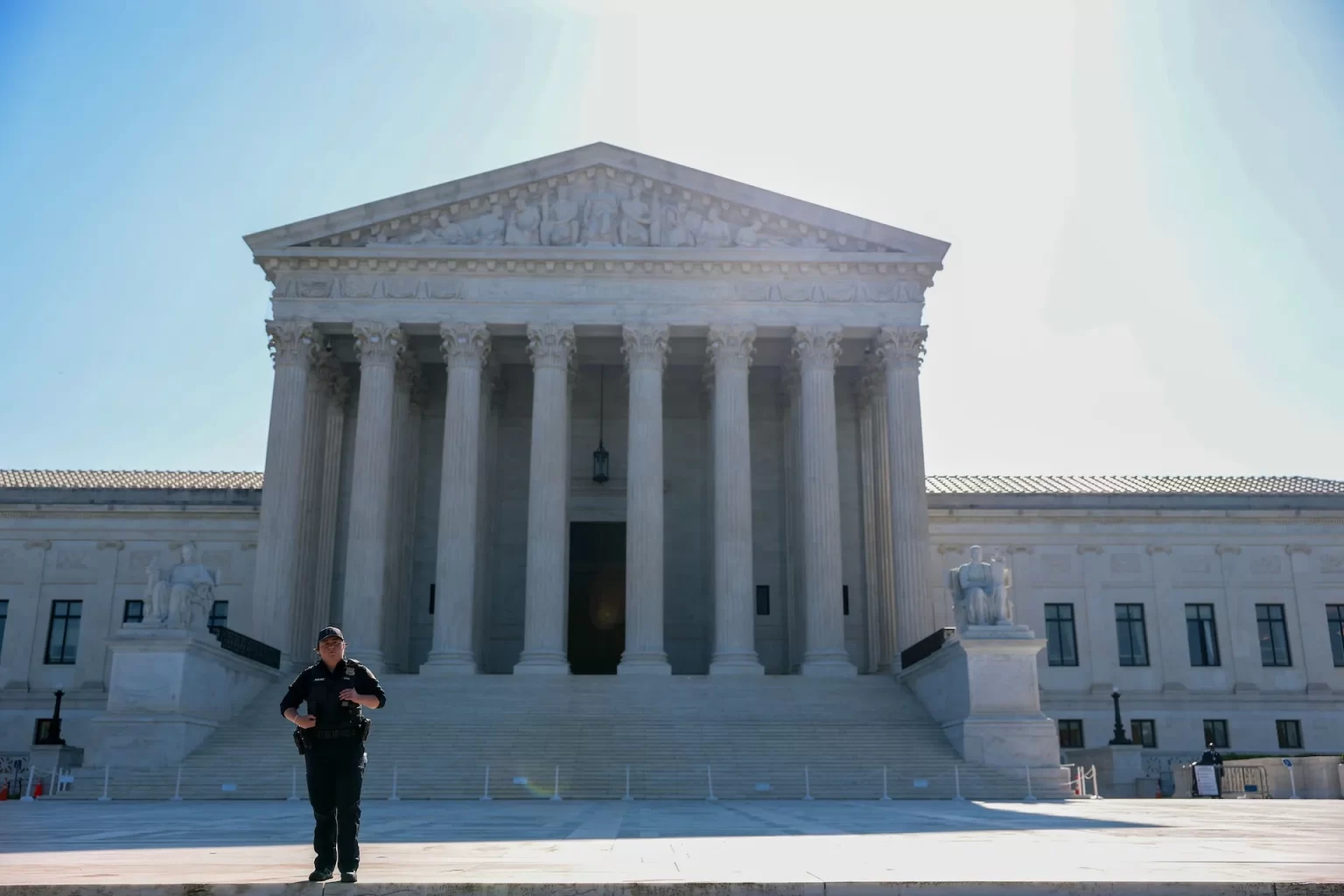
Supreme Court justices lobbed sharp questions at both sides about the constitutionality of geofence warrants during oral arguments Monday in a case that could have broader implications for law enforcement collection of Americans’ data.
Chatrie v. The United States stems from the 2019 conviction of Okello Chatrie in a bank robbery, where authorities obtained location data from Google about people within a specific area at a specific time.
In questioning an attorney for the petitioner, Adam Unikowsky, a number of conservative justices — including Chief Justice John Roberts — asked why the government shouldn’t be allowed to access location data taken from a third party given that Chatrie had “opted-in” to share that data.
“I just don’t agree that one should have to flip off one’s location history as well as other cloud services to avoid government surveillance,” Unikowsky answered, raising whether the government was entitled to getting emails or calendar data that are also stored in the cloud. (Google has since moved location data to users’ individual devices.)
Some liberal justices, too, had skeptical questions for Unikowsky. “This identifies a place, a crime — a limited time frame, but a time frame,” Sonia Sotomayor said, referring to protections from open-ended searches under the Fourth Amendment. “So it’s not a general warrant in this historical sense.” But she also said that because location data follows users everywhere: “When the police are searching or asking for a search result, there’s no way to predict whether they’re going to invade your privacy.”
The line of questioning about how far a government request for bulk data can go continued from both conservative and liberal justices when it was the government’s turn to argue its position. Justices probed skeptically about what made emails or calendar data different, and whether the government could do a physical search of all of the lockers in a storage facility to find one gun they believed might be there.
It was an unusually long session for the Supreme Court, going two hours. A ruling could come in June or July. Predicting how a court will decide based on justices’ questions is famously fraught. Only one justice, Samuel Alito, hinted strongly at how he was likely to decide.
“I’m struggling to understand why we are here in this case, other than the fact that at least four of us voted to take it,” he said. He said he didn’t believe anything new of note could come out of the court based on lower court rulings during questioning of Unikowsky. “We are all free to write law review articles on this fascinating subject, but that seems like that’s what you’re asking for.”
Orin Kerr, a Stanford University law professor who filed a friend of the court brief on the government’s side, said he believed based on the oral arguments that the court will say geofence warrants can be drafted lawfully.
“The Justices seem likely to reject the broader argument Chatrie made about the lawfulness of the warrant,” he wrote on social media. “They’ll probably say the geofence warrants have to be limited in time and space.”
Casey Waughn, a privacy lawyer and senior associate at Armstrong Teasdale, was struck by the absence of a major focus on “third-party doctrine,” under which there’s no reasonable expectation of privacy when citizens give their information to an outside party like a bank.
She also honed in on arguments Unikowsky made.
“His argument really gave two lines to go down for the judges, and one was that you have a property interest in your data on the cloud, and the other was that you have a reasonable expectation of privacy for your data on the cloud,” she told CyberScoop. “And historically, both of those avenues have been grounds on which the Court has found that …issue is protected under the Fourth Amendment, and therefore that the actions constituted a search. So I thought it was interesting that he went and kind of argued both of those lanes.”
Alan Butler, executive director of the Electronic Privacy Information Center that filed a friend of the court brief on the side of the petitioner, said the stakes in the case are high.
“Today’s arguments underscored that the Supreme Court is weighing one of the most consequential privacy questions of the digital age: whether the government can use sweeping location data searches to identify a suspect,” he said in a statement after the arguments. “The Court should hold that the Constitution protects our digital data even when it is stored by an app or cloud provider. The Court should ensure that the highly sensitive records generated by our phones cannot be obtained without particularized suspicion and close judicial oversight.”
The post Supreme Court justices skeptically question both sides in geofence surveillance case appeared first on CyberScoop.
–
Read More – CyberScoop