Moody’s recently reported that global investment in data centers will surpass $3 trillion over the next five years, driven by AI capacity growth and hyperscaler demand. As big tech companies, banks, and institutional investors pour capital into these projects, data center developers and their financial sponsors must prioritze cybersecurity.
Moody’s said that data center investments made by the six largest U.S. cloud computing providers — Microsoft, Amazon, Alphabet, Oracle, Meta, and CoreWeave — approached $400 billion last year. The firm anticipates that annual global investment will grow by $200 billion over the next two years.
Real estate firm Jones Lang LaSalle forecasted similar investment flows in a separate report published earlier this year, projecting that “nearly 100 GW of new data centers will be added between 2026 and 2030, doubling global capacity.” JLL said that this infrastructure investment “supercycle,” one of the largest in the modern era, will result in $1.2 trillion in real estate asset value creation and the need for roughly $870 billion of new debt financing.
In concert, these reports reflect a growing reality: Data centers are strategic, interconnected infrastructure supporting our manufacturing, national security, and communication systems. Cyber disruptions, whether through ransomware, supply-chain compromise, or operational technology (OT) compromises, can cascade beyond a single facility, threatening grid stability, cloud services, economic activity, and public safety.
Data centers are now critical hubs of energy demand and digital dependency. Their cybersecurity posture is directly tied to the resilience of the industrial and energy ecosystem that support them. For investors and stakeholders, cybersecurity should be fundamental to asset value and risk management. Strong cybersecurity directly affects uptime guarantees, regulatory exposure, insurance coverage, financing terms, and long-term valuation.
The most significant cybersecurity risks now center on three critical areas: data center-grid convergence, supply-chain vulnerabilities, and secure-by-design considerations. Data center operators and their financial backers must address these interconnected threats to protect both individual facilities and the broader system they support.
Hardwired for risk
The cybersecurity challenge facing the data center supercycle stems from how these campuses are tightly coupled with both the public power grid and their own industrial control systems. As hyperscale and AI‑optimized facilities proliferate, their constant demand for high‑quality electricity shapes grid planning and reliability. These large campuses function less like traditional real estate and more like critical energy infrastructure nodes.
This shift comes as grid capacity tightens. The North American Electric Reliability Corporation (NERC) has warned that demand from new data centers will outpace energy supply growth in the coming years. A cyber incident that disrupts a major data center or degrades its industrial control systems can propagate into regional grid reliability issues, contract penalties, and broader economic disruption.
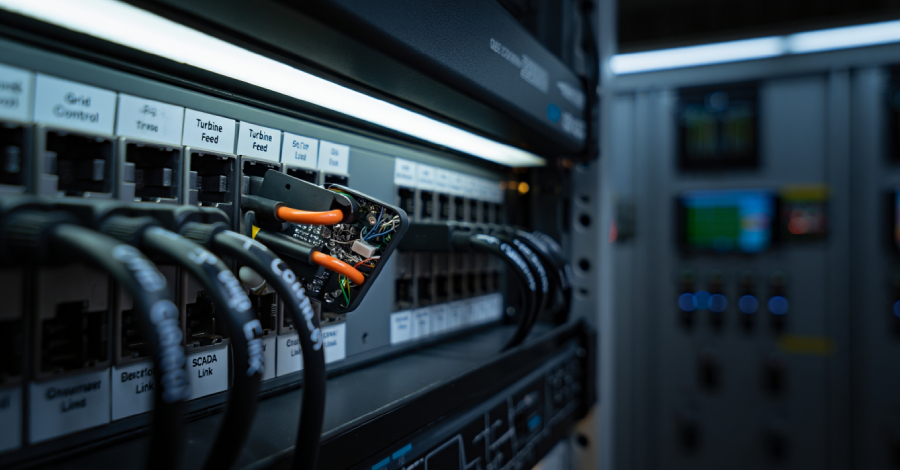
At the same time, the OT running these sites — building management, systems, cooling controls, battery and generator management — create dense cyber‑physical exposure. Global insurer Marsh notes that events in these systems, whether from human error or cyberattack, can cause physical damage and significant business interruption. The 2021 OVHcloud data center fire in Strasbourg, France destroyed an entire facility and disrupted services for thousands of customers, showing how failures in fire protection and cooling systems rapidly escalate. into catastrophic loss. Those safety functions now run through interconnected, remote-access-enabled OT systems.
Secure‑by‑design architectures for both grid‑side interfaces and on‑site OT are prerequisites for preventing this rapidly expanding energy–data infrastructure from becoming a single, converged point of failure.
Supply-chain integrity first
AI‑optimized campuses depend on massive volumes of GPUs, high‑density servers, network appliances, OT controllers, and edge devices. Many of these components are designed, manufactured, or assembled in jurisdictions at the center of great‑power competition, particularly China. Reports warn that state-aligned actors could introduce backdoors, malicious firmware, or weaponize delivery timelines to create strategic outages.
Secure‑by‑design must start at procurement. Security-conscious procurement requires stringent vendor due diligence, diversification away from single‑country dependencies, hardware and firmware validation before deployment, and alignment with export controls and national‑security guidance on high‑risk equipment. The bill of materials (BoM) for a modern data center must be treated like a living threat surface, with traceability from chip manufacture through installation, including approved vendor lists, tamper‑evident logistics, and mandatory firmware attestation.
Procurement teams need escalation paths for opaque supply chains, unexplained cost changes, or “gray‑market” alternatives, plus playbooks for rapidly substituting vendors when geopolitical shocks or sanctions make a product line unacceptable.
Governance around supply‑chain risk must reach the same level as power, cooling, and uptime guarantees in contracts with hyperscalers and large tenants. Secure‑by‑design campuses will embed requirements for hardware provenance, firmware update hygiene, and ongoing vulnerability disclosure into master service agreements and construction/operations contracts, with clear accountability when a supplier is implicated in espionage or sabotage.
Data center sponsors who cannot prove supply‑chain integrity will face growing pressure from regulators, insurers, and investors who see hardware trust as a prerequisite for AI and cloud infrastructure resilience.
Securing the infrastructure supply chain pipeline
Engineering secure-by-design campuses begins with assuming adversaries will target internet‑exposed and OT edge devices. Security architects must design environments that prevent any foothold at the edge from escalating into grid‑scale disruption or safety‑critical failure.
Geopolitically motivated campaigns against energy infrastructure are accelerating. Recent Russia-nexus attacks on the Polish power system and Romania’s national oil pipeline demonstrate that state‑linked and criminal groups see energy and digital infrastructure as leverage points. Last December, actors linked to Russia’s Sandworm APT compromised remote terminal units (RTUs), firewalls, and communications gateways at Polish substations and distributed energy facilities.
This precedent-setting cyberattack—the first to directly target distributed energy resources in a NATO member’s power system—is indicative of the current threat landscape. Sandworm’s campaign underscores how fragile edge devices are and how vital it is to harden the gateways at the OT boundary. The first pillar of secure-by-design campuses is disciplined network segmentation that treats OT as a distinct, high‑consequence domain.
OT networks should be carved into functional and geographic zones—separating building management from generator controls, from battery systems, from grid‑interconnection protection—with tightly controlled conduits between them, enforced by OT‑aware firewalls and protocol‑constrained paths.
Hardware‑enforced unidirectional gateways and data diodes offer uniquely strong protection at key boundaries. Data diodes allow telemetry and process data to flow outward from OT to IT and monitoring systems while physically blocking any return path, sharply reducing the chances that a web-based intrusion can reach OT systems.
Data diodes should be placed at key demarcation points—between the data center’s OT and corporate IT, between on‑site generation controls and the broader campus, and at interfaces with utility systems—so operators preserve visibility without exposing those domains to bidirectional network risk.
A second foundational element of secure‑by‑design campuses is a clear, continuously maintained OT asset inventory capturing every PLC, RTU, relay, drive, building controller, gateway, sensor, and engineering workstation, along with its network location, firmware version, vendor, and criticality. Effective segmentation depends on knowing what you have and how it communicates.
Operators cannot isolate critical power and cooling functions, or confidently place diodes and firewalls, without understanding which devices participate in those functions and which paths they rely on. This inventory must fully cover the same class of gateways and field devices abused in the Polish grid attack.
When asset inventories are linked to configuration and vulnerability management, operators can quickly identify exposed OT devices when they are approaching end of life or when new flaws are disclosed. A comprehensive OT asset inventory also enables security teams to quickly locate high‑risk remote access paths and prioritize segments for additional hardening.
Secure‑by‑design engineering mandates the mitigation of accelerating cyber risks posed by remote access gateways and the mass-automation of industrial functions. Every orchestration platform, management API, and remote session is a potential high‑impact attack vector. This threat model requires consolidating OT access through hardened jump hosts with strong authentication and just‑in‑time privileges; sharply limiting what automation tools can change on OT networks, enforcing strict segregation between automation platforms and safety‑critical functions, continuously monitoring automated and remote actions, and hardening configuration‑management workflows.
Lastly, secure‑by‑design architecture demands OT‑aware visibility that can actually see and understand what is happening on control networks. This means instrumenting OT segments with monitoring tuned to industrial protocols and behaviors, correlating alerts with asset context, and wiring those insights into playbooks that can quickly isolate, triage, and physically replace compromised edge devices before an intrusion escalates.
Resilience is the only path to funding
The threat modeling, procurement, and design best practices detailed here directly constrain the blast radius of geopolitically charged campaigns that threaten data center reliability and safety. Data center developers, operators, and investors need this systems‑level blueprint for building AI‑era campuses that remain resilient as the energy and threat landscape becomes more contested.
Banks and institutional sponsors are deploying trillions of dollars in construction, fit‑out, and power capacity on the assumption that AI demand will translate into durable, high‑availability cash flows. Underinvesting in cybersecurity directly threatens covenants, refinancing options, insurance coverage, and asset valuation. Outages, safety incidents, or regulatory findings will capsize the investment thesis.
The campuses that will secure the best financing over the next decade will be those that can point to their secure‑by‑design architectures, campus-wide OT governance, and defensible supply‑chain practices. In this intertwining infrastructure supercycle and macro OT threat environment, power usage efficiency (PUE) metrics and fast build schedules will matter less that proven security safeguards.
The stakes are escalating rapidly. Developers and utilities are pairing energy‑hungry data centers with small modular reactors (SMRs) and other non‑traditional power generation. These campuses will converge with the security and risk profile of nuclear and high‑hazard industrial facilities, bringing heightened regulations and adversary interest.
SMR data centers fundamentally change the threat model. When nuclear systems sit alongside AI clusters, secure-by-design takes on a new dimension. Operators, investors, regulators, and security professionals must prepare for this convergence. The integration of compute and power generation creates a dynamic that demands the security rigor of both digital and infrastructure and nuclear facilities. The window to build these protections into design is closing.
Jeffrey Knight is Director of Global Critical Infrastructure Services at InfraShield. Jeff brings more than 35 years of experience in nuclear engineering and cybersecurity across the Department of Defense (DoD), SWIFT, the NRC, and the Department of Energy (DOE) National Laboratory complex.
The post Why ‘secure-by-design’ systems are non-negotiable in the AI era appeared first on CyberScoop.
–
Read More – CyberScoop