
If you just want to read the contest rules, click here.
Willkommen zurück, meine Damen und Herren, zu unserem zweiten Wettbewerb in Berlin! That’s correct (if Google translate didn’t steer me wrong). After our inaugural competition last year, Pwn2Own returns to Berlin and OffensiveCon. Outside of our shipping troubles, we had an amazing time and can’t wait to get back.
Last year, we added Artificial Intelligence as a category with great results. This year, we’re expanding this and splitting it into multiple different categories: AI Databases, Coding Agents, Local Inferences, and a separate category for NVIDIA products. In last year’s contest, NVIDIA targets had wins, losses, and collisions, so it will be interesting to see how they fare this year. The folks from AWS wanted to get into the fray as well, so they stepped up to co-sponsor this year’s event, which allows us to increase the reward for bugs in Firecracker. Of course, we have all of the returning categories as well, including web browsers, containers, servers, virtualization, and operating systems. There’s more than $1,000,000 in cash and prizes available for contestants. Last year, we awarded $1,078,750 for 28 unique 0-days over the three-day event. We’ll see if we can eclipse those numbers in 2026.
The contest begins on May 14, but registration closes on May 7, so don’t delay in getting those submissions in. We’re hoping for maximum participation, so set aside your vibe coding and show us what you can really do. We’re looking forward to some cutting-edge exploitation on display. For 2026, we have a total of 31 targets across 10 categories. Here is a full list of the categories for this year’s event:
— Virtualization
— Web Browser
— Enterprise Applications
— Servers
— Local Escalation of Privilege
— Containers
— AI Database
— Coding Agents
— Local Inference
— NVIDIA
Of course, no Pwn2Own competition would be complete without us crowning a Master of Pwn (Meister von Pwn?). Since the order of the contest is decided by a random draw, contestants with an unlucky draw could still demonstrate fantastic research but receive less money since subsequent rounds go down in value. However, the points awarded for each unique, successful entry do not go down. Someone could have a bad draw and still accumulate the most points. The person or team with the most points at the end of the contest will be crowned Master of Pwn, receive 65,000 ZDI reward points (enough for Platinum status), a killer trophy, and a pretty snazzy jacket to boot.
Let’s look at the details of the rules for this year’s event.
Virtualization Category
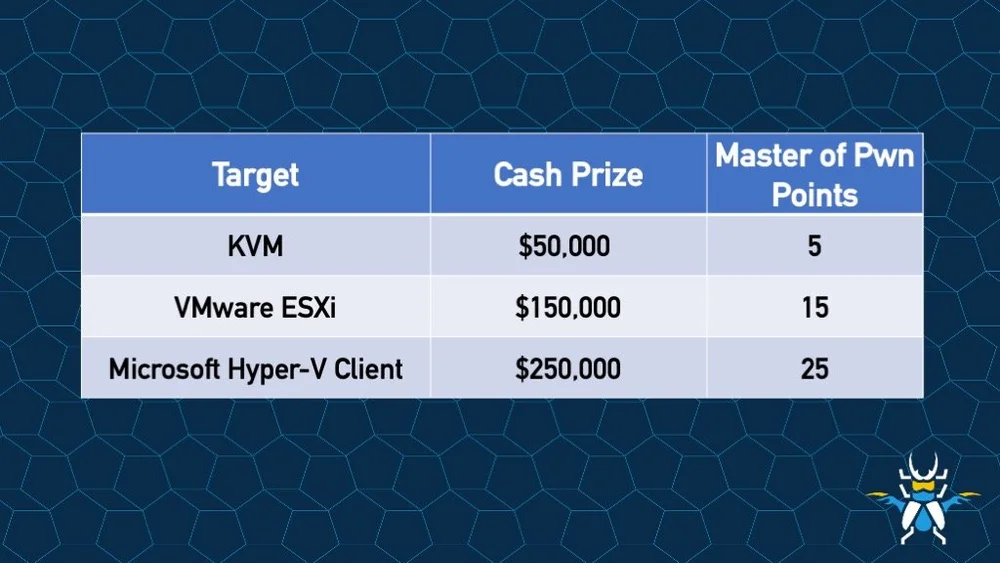
Some of the highlights for each contest can be found in the Virtualization Category, and we’re thrilled to see what this year’s event could bring with it. As usual, VMware is the main highlight of this category as we’ll have VMware ESXi return with an award of $150,000. Last year produced the first ESXi exploits in Pwn2Own history, so it will be interesting to see if we get more. Microsoft also returns as a target and leads the virtualization category with a $250,000 award for a successful Hyper-V Client guest-to-host escalation. Kernel-based Virtual Machine (KVM) is our final target in this category with a prize of $50,000.
There’s an add-on bonus in this category as well. If a contestant can escape the guest OS, then gain arbitrary code execution on the virtualization target and obtain arbitrary code execution in the guest operating system on a separate virtual machine managed by the same targeted virtualization target, they’ll earn another $50,000. That could push the payout on a ESXi bug to $200,000. This bonus is for KVM and ESXi only. Here’s a detailed look at the targets and available payouts in the Virtualization category:
Web Browser Category
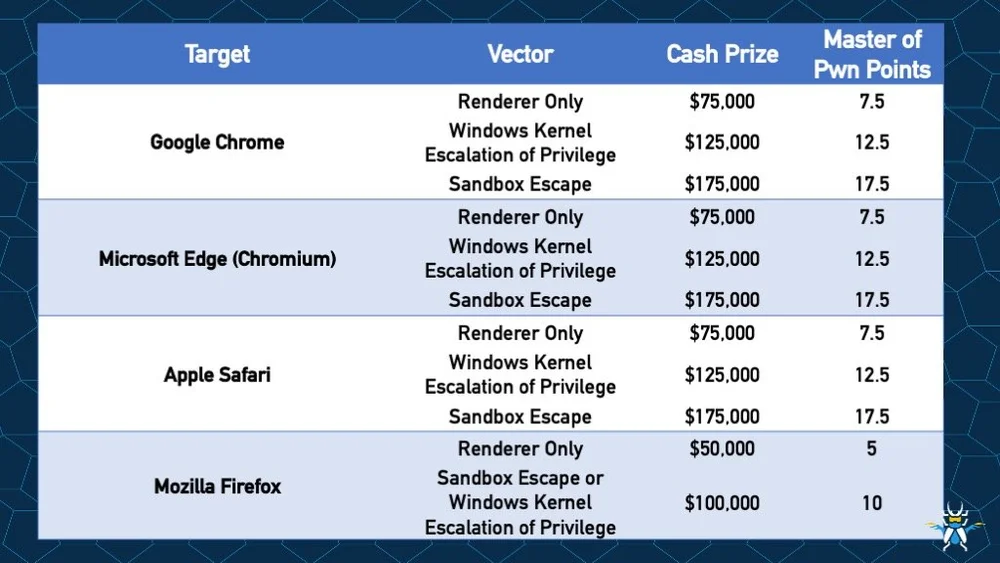
While browsers are the “traditional” Pwn2Own target, we’re continuously tweaking the targets in this category to ensure they remain relevant. We re-introduced renderer-only exploits a couple of years ago, and this year, we’ve increased the award to $75,000. In fact, we’ve increased the awards across the board for this category. Here’s a detailed look at the targets and available payouts:
Enterprise Applications Category
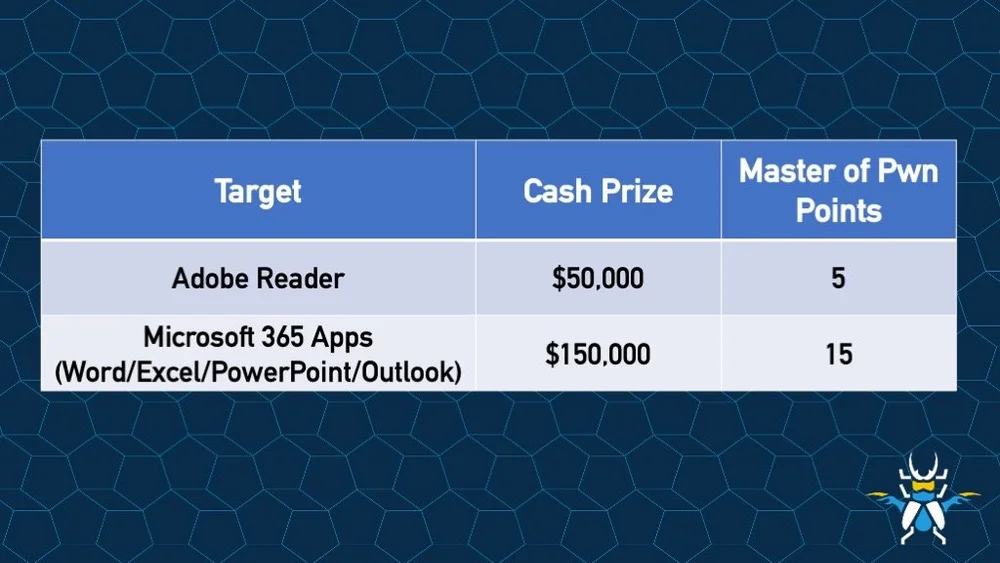
Enterprise applications return as targets with Adobe Reader and various Office components on the target list once again. Attempts in this category must be launched from the target under test. For example, launching the target under test from the command line is not allowed. Prizes in this category run from $50,000 for a Reader exploit with a sandbox escape or a Reader exploit with a kernel privilege escalation, and $150,000 for an Office 365 application. Word, Excel, and PowerPoint are all valid targets. Microsoft Office-based targets will have Protected View enabled where applicable. Adobe Reader will have Protected Mode enabled where applicable.
This year, we’re adding a bonus for Copilot data exfiltration and Copilot action execution. Microsoft just patched a bug like this in Excel, so we know they are out there. If you’re able to exploit Copilot in addition to a Microsoft application, you’ll earn an additional $50,000. There are quite a few rules and scenarios around this add-on, so be sure to read the rules carefully and contact us with questions. Here’s a detailed view of the targets and payouts in the Enterprise Application category:
The Server Category
The Server Category for 2026 focuses solely on the server components we’re most interested in. These servers are often targeted by everyone from ransomware crews to nation/state actors, so we know there are exploits out there for them. The only question is whether we’ll see any of the competitors bring one of those exploits to Pwn2Own. Last year, the bugs demonstrated in SharePoint ended up being exploited in the wild, so we know people are looking for these with great interest. Microsoft Exchange has been a popular target for some time, and it returns as a target this year as well, with a payout of $200,000. This category is rounded out by Microsoft Windows RDP/RDS, which also has a payout of $200,000. Here’s a detailed look at the targets and payouts in the Server category:

Local Escalation of Privilege Category
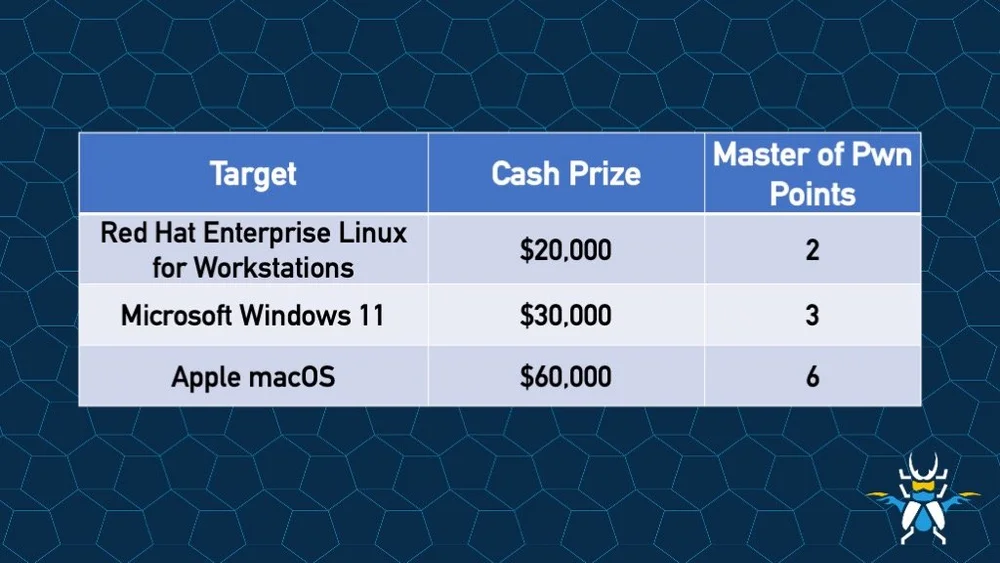
This category is a classic for Pwn2Own and focuses on attacks that originate from a standard user and result in executing code as a high-privileged user. A successful entry in this category must leverage a kernel vulnerability to escalate privileges. Red Hat Enterprise Linux for Workstations returns as our Linux-based target, while Apple macOS, and Microsoft Windows 11 return as targets in this category. Prior exploits in this category have won Pwnie awards, so they’re always interesting to see. Here’s a detailed look at the targets and payouts in this category:
The Container Category
We’re excited to have this category return for its third season, and we’re hopeful that even more contestants will target one of these container targets. For an attempt to be ruled a success against these three, the exploit must be launched from within the guest container/microVM and execute arbitrary code on the host operating system. Again, with help from AWS, Firecracker returns as a target with a prize of $100,000. Here are the targets and payouts for this category:

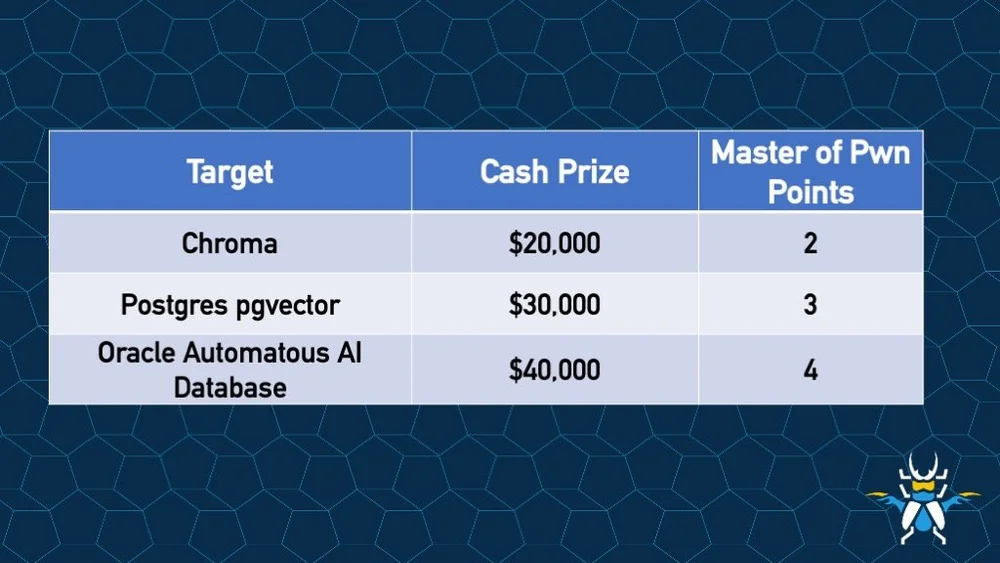
AI Database Category
In the past, AI Hackathons have focused on using AI to develop vulnerabilities or other offensive frameworks. We’re opening up the models and various components themselves for exploitation. The first AI sub-category focuses on databases. An attempt in this category must be launched from the contestant’s laptop. Here’s a look at the targets and awards in the AI Database category:
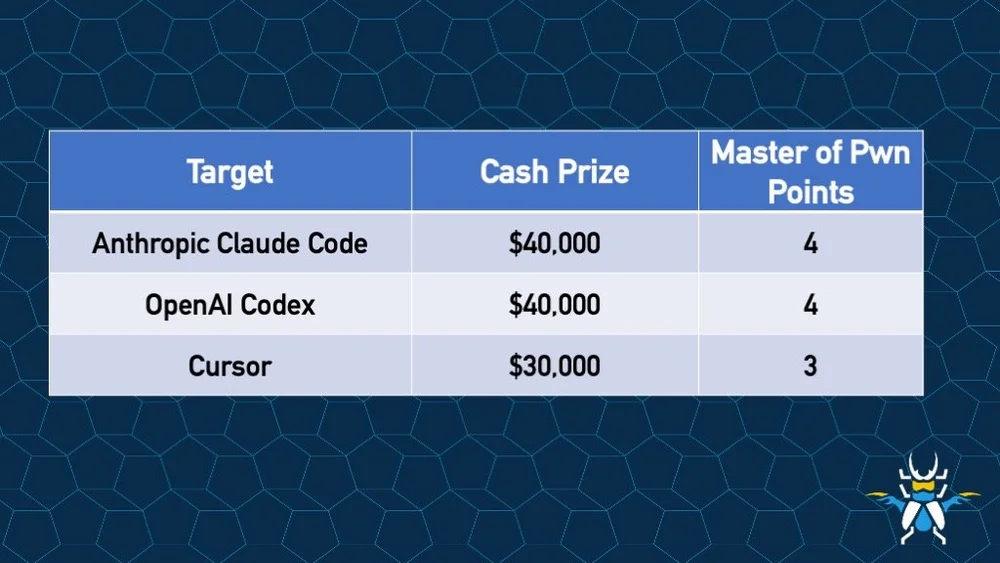
The Coding Agent Category
Let’s face it. At some point or another, we’ve probably all vibe coded something. There’s no shame in that, but how secure are the tools we use for vibe coding? Well, let’s take the most popular choices and find out. A successful entry must interact with a contestant-controlled resource (e.g. web page, repository, media file) to exploit a vulnerability within the coding agent. The attack vector of the entry must be a common coding agent use case. There are few things out of scope here as well. UI spoofing or misrepresentation unrelated to permission prompts, model jailbreaks or prompt outputs that do not cross security boundaries, and vulnerabilities that require unsafe or permission-less modes are just a few of the things not allowed. As this is a new category, please read the rules carefully to ensure your entry qualifies. Here’s a look at the targets and awards in the AI Coding Agent category:
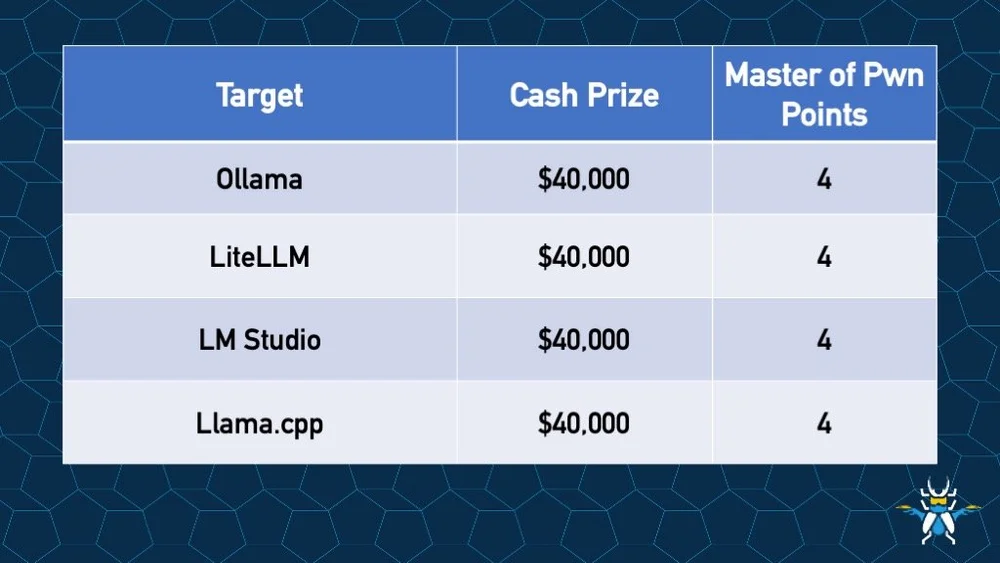
The Local Inference Category
We couldn’t leave local inference and LLMs out of Pwn2Own. These products claim to provide enhanced data privacy, zero-cost inference, lower latency, and fully offline functionality. We’ll see how the security stacks up. An attempt in this category must be launched from the contestant’s laptop within the contest network. Here are the targets and payouts for the Local Inference category:
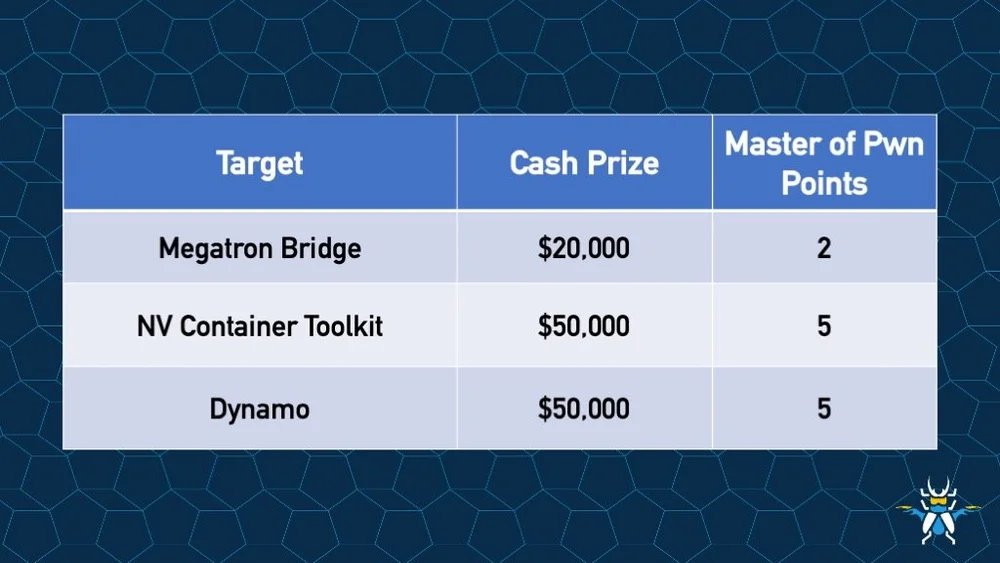
The NVIDIA Category
Our last AI sub-category focuses solely on NVIDIA products. For network accessible targets, an attempt must be launched from the contestant’s laptop within the contest network. For NV Container Toolkit, the attempt must be launched from within a crafted container image and execute arbitrary code on the host operating system. For Megatron Bridge, entries that leverage vulnerabilities pertaining to pickle deserialization or that leverage a vulnerability when “trust_remote_code=true” are out of scope. Here are the targets and payouts for the NVIDIA category:
Conclusion
The complete rules for Pwn2Own Berlin 2026 are found here. As always, we highly encourage entrants to read the rules thoroughly if they choose to participate. If you are thinking about participating but have specific configuration or rule-related questions, email us. Questions asked over X (nee Twitter), BlueSky, or other means will not be answered. Registration is required to ensure we have sufficient resources on hand at the event. Please contact ZDI at [email protected] to begin the registration process. Registration for onsite participation closes at 5 p.m. Central European Time on May 7, 2026.
Be sure to stay tuned to this blog and follow us on Twitter, Mastodon, LinkedIn, or Bluesky for the latest information and updates about the contest. We look forward to seeing everyone in Germany, and we hope to see some of the best in the world show what they can do – vibe coded or not.
With special thanks to our Pwn2Own Berlin 2026 partners AWS, for providing their expertise and technology.

© 2026 Trend Micro Incorporated. All rights reserved. PWN2OWN, ZERO DAY INITIATIVE, ZDI, ZERO DAY INITIATIVE, TrendAI, and Trend Micro are trademarks or registered trademarks of Trend Micro Incorporated. All other trademarks and trade names are the property of their respective owners.
–
Read More – Zero Day Initiative – Blog